Buy reiseführer.eu ?
We are moving the project
reiseführer.eu .
Are you interested in purchasing the domain
reiseführer.eu ?
domain@kv-gmbh.de · 0541-91531010
Buy reiseführer.eu ?
Is there a definition for adjacent angles? What distinguishes adjacent angles, supplementary angles, and adjacent angles?
Yes, there is a definition for adjacent angles. Adjacent angles are two angles that share a common vertex and a common side, but do not overlap. Supplementary angles are two angles whose measures add up to 180 degrees, while adjacent angles are two angles that share a common side and vertex. The key distinction between adjacent angles and supplementary angles is that supplementary angles do not have to share a common side or vertex. **
What is an adjacent septum piercing?
An adjacent septum piercing is a type of piercing that is done next to the traditional septum piercing. It involves getting two piercings on either side of the septum, creating a symmetrical look. This type of piercing is often chosen by individuals looking to add more uniqueness and style to their septum piercing. It can be a bold and eye-catching choice for those who want to stand out. **


Similar search terms for Adjacent
Top-Angebote
Products related to Adjacent:
-
Euro Cuisine Greek Yogurt Maker by Euro Cuisine in WhiteNow you can prepare Greek yogurt dishes quickly and easily with Euro Cuisine! This unique strainer kit which is BPA Free transforms up to 2qts of ordinary Euro Cuisine homemade yogurt or store bought yogurt into thick, creamy Greek yogurt in a...29,99 $*Shipping: 11,98 $Secure redirect to the provider
-
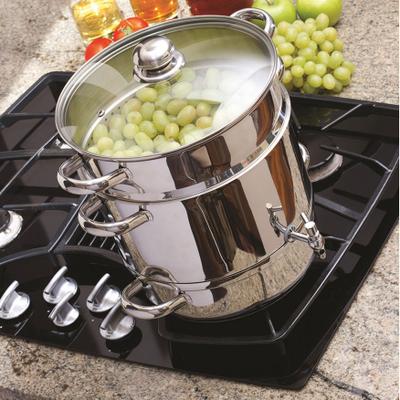
Euro Cuisine Stove Top Steam Juicer by Euro Cuisine in Stainless SteelThe Euro Cuisine Stainless Steel steam juicer, with our specially designed spigot, will extract 100% pure and delicious juice with the power of steam from all sorts of fruit such as Grapes, Apples, Pears, Currants, Raspberries, Strawberries,...99,99 $*Shipping: 23,98 $Secure redirect to the provider
-
Urban Nature Culture Vase RelaxedQuiet elegancy comes to life in Urban Nature Culture's vase Relaxed. Handmade in Portugal, this ceramic vase has a shape beyond anything you've seen - it's organic, it flows and steals your heart with its playful ear.123,40 $*Shipping: 0,00 $Secure redirect to the provider



-
Where is the adjacent side located?
The adjacent side is located next to the angle of interest in a right-angled triangle. It is the side that forms the angle with the hypotenuse. In trigonometry, the adjacent side is used in conjunction with the hypotenuse to calculate the cosine of an angle. **
-
What are adjacent angles in 7th grade?
In 7th grade, adjacent angles are two angles that share a common side and a common vertex, but do not overlap. They are side by side and do not share any interior points. Adjacent angles add up to 180 degrees when they form a straight line. Understanding adjacent angles is important in geometry as it helps in identifying relationships between angles in various geometric figures. **
-
How can one expand the adjacent barn?
To expand the adjacent barn, one could consider adding additional sections or wings to the existing structure. This could involve extending the roofline and walls to create more space. Another option could be to build a separate but connected structure next to the barn to increase storage or working space. It is important to consult with a professional builder or architect to ensure that any expansion plans are structurally sound and comply with local building codes. **
-
What is the distance between adjacent roots?
The distance between adjacent roots of a plant can vary depending on the species and the size of the plant. In general, the distance between adjacent roots is typically around 1-2 times the diameter of the plant's canopy. This spacing allows the roots to have enough room to spread out and access water and nutrients in the soil without competing too much with neighboring roots. However, some plants may have roots that are closer together, especially in dense or crowded growing conditions. **


What is the adjacent side of alpha?
The adjacent side of angle alpha in a right-angled triangle is the side that is next to angle alpha and forms the right angle with the hypotenuse. It is the side that is not the hypotenuse and is adjacent to the angle of interest. The length of the adjacent side can be found using trigonometric functions such as cosine, which relates the adjacent side to the hypotenuse and the angle. **
What is the reflection of adjacent wavelengths?
The reflection of adjacent wavelengths refers to the phenomenon where light waves of different wavelengths are reflected off a surface. When light waves with adjacent wavelengths, such as red and orange, hit a surface, they may be reflected at different angles or with different intensities. This can result in the separation of colors, as seen in a rainbow or in the iridescence of certain materials. The reflection of adjacent wavelengths is a key factor in the perception of color and the behavior of light. **
Top-Angebote
Products related to Adjacent:
-
Euro Cuisine Portable Blender by Euro Cuisine in GreenMake delicious smoothies, healthy drinks and treats quickly with your Mini Mixx personal blender by Euro Cuisine. Just add your favorite fruits, vegetables, juice, ice and then press down to blend. When your drink is ready, simply remove the blade...44,99 $*Shipping: 13,98 $Secure redirect to the provider
-
Euro Cuisine 8-Cup Percolator by Euro Cuisine in CopperThe Euro Cuisine 8-Cup model of classic stainless steel percolator with Copper Finish and keep warm function brings coffee making to your kitchen. Piping hot water percolates through the grounds, and pulses up into the glass knob on top to create...69,99 $*Shipping: 16,98 $Secure redirect to the provider
-
Euro Cuisine Greek Yogurt Maker by Euro Cuisine in WhiteNow you can prepare Greek yogurt dishes quickly and easily with Euro Cuisine! This unique strainer kit which is BPA Free transforms up to 2qts of ordinary Euro Cuisine homemade yogurt or store bought yogurt into thick, creamy Greek yogurt in a...29,99 $*Shipping: 11,98 $Secure redirect to the provider
-
Euro Cuisine Stove Top Steam Juicer by Euro Cuisine in Stainless SteelThe Euro Cuisine Stainless Steel steam juicer, with our specially designed spigot, will extract 100% pure and delicious juice with the power of steam from all sorts of fruit such as Grapes, Apples, Pears, Currants, Raspberries, Strawberries,...99,99 $*Shipping: 23,98 $Secure redirect to the provider
-
Is there a definition for adjacent angles? What distinguishes adjacent angles, supplementary angles, and adjacent angles?
Yes, there is a definition for adjacent angles. Adjacent angles are two angles that share a common vertex and a common side, but do not overlap. Supplementary angles are two angles whose measures add up to 180 degrees, while adjacent angles are two angles that share a common side and vertex. The key distinction between adjacent angles and supplementary angles is that supplementary angles do not have to share a common side or vertex. **
-
What is an adjacent septum piercing?
An adjacent septum piercing is a type of piercing that is done next to the traditional septum piercing. It involves getting two piercings on either side of the septum, creating a symmetrical look. This type of piercing is often chosen by individuals looking to add more uniqueness and style to their septum piercing. It can be a bold and eye-catching choice for those who want to stand out. **
-
Where is the adjacent side located?
The adjacent side is located next to the angle of interest in a right-angled triangle. It is the side that forms the angle with the hypotenuse. In trigonometry, the adjacent side is used in conjunction with the hypotenuse to calculate the cosine of an angle. **
-
What are adjacent angles in 7th grade?
In 7th grade, adjacent angles are two angles that share a common side and a common vertex, but do not overlap. They are side by side and do not share any interior points. Adjacent angles add up to 180 degrees when they form a straight line. Understanding adjacent angles is important in geometry as it helps in identifying relationships between angles in various geometric figures. **
Similar search terms for Adjacent
-
Urban Nature Culture Vase RelaxedQuiet elegancy comes to life in Urban Nature Culture's vase Relaxed. Handmade in Portugal, this ceramic vase has a shape beyond anything you've seen - it's organic, it flows and steals your heart with its playful ear.123,40 $*Shipping: 0,00 $Secure redirect to the provider
-
How can one expand the adjacent barn?
To expand the adjacent barn, one could consider adding additional sections or wings to the existing structure. This could involve extending the roofline and walls to create more space. Another option could be to build a separate but connected structure next to the barn to increase storage or working space. It is important to consult with a professional builder or architect to ensure that any expansion plans are structurally sound and comply with local building codes. **
-
What is the distance between adjacent roots?
The distance between adjacent roots of a plant can vary depending on the species and the size of the plant. In general, the distance between adjacent roots is typically around 1-2 times the diameter of the plant's canopy. This spacing allows the roots to have enough room to spread out and access water and nutrients in the soil without competing too much with neighboring roots. However, some plants may have roots that are closer together, especially in dense or crowded growing conditions. **
-
What is the adjacent side of alpha?
The adjacent side of angle alpha in a right-angled triangle is the side that is next to angle alpha and forms the right angle with the hypotenuse. It is the side that is not the hypotenuse and is adjacent to the angle of interest. The length of the adjacent side can be found using trigonometric functions such as cosine, which relates the adjacent side to the hypotenuse and the angle. **
-
What is the reflection of adjacent wavelengths?
The reflection of adjacent wavelengths refers to the phenomenon where light waves of different wavelengths are reflected off a surface. When light waves with adjacent wavelengths, such as red and orange, hit a surface, they may be reflected at different angles or with different intensities. This can result in the separation of colors, as seen in a rainbow or in the iridescence of certain materials. The reflection of adjacent wavelengths is a key factor in the perception of color and the behavior of light. **
* All prices are inclusive of VAT and, if applicable, plus shipping costs. The offer information is based on the details provided by the respective shop and is updated through automated processes. Real-time updates do not occur, so deviations can occur in individual cases. ** Note: Parts of this content were created by AI.